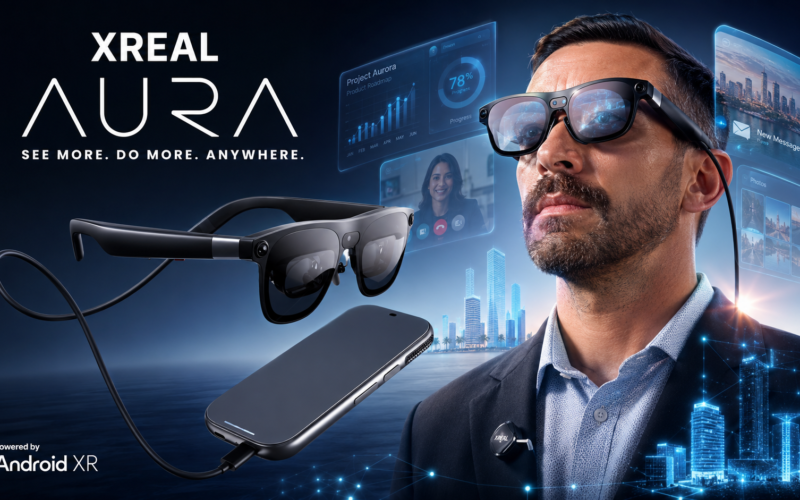
911Reviews recently got an early hands-on look at XREAL AURA, a new pair of smart glasses powered by Android XR, and the experience left Adam and Amy Nash thinking seriously about the future of work, travel, and spatial computing.
Over the years, the 911Reviews team has tested everything from robots and smart cars to cutting-edge gadgets at major technology expos around the world. But according to Adam Nash, some products stand out because they shift expectations.
“Every once in a while, we have the opportunity to see something that changes our perception of what’s possible,” said Adam Nash of 911Reviews. “That’s what we experienced with XREAL AURA.”
At first, Adam said he expected another augmented reality demonstration. The team has seen AR glasses, virtual displays, and immersive technology before, but many previous products felt more impressive as concepts than as practical everyday tools.
Aura, however, made a different first impression.
“The first surprise was simply putting them on,” Adam said. “Instead of putting on a headset, I was putting on a pair of glasses, and it felt remarkably natural.”
Weighing under 95 grams, the glasses felt light and comfortable during the demonstration. Adam said that after a few minutes, the hardware started to fade into the background, allowing the experience itself to take over.
“The best technology eventually disappears into the experience,” Adam said. “You stop noticing the device and start focusing on what it allows you to do.”
One of the biggest highlights was the virtual workspace. Multiple screens appeared in front of Adam, floating naturally in space. Unlike small or cramped virtual windows, the displays felt large enough to be genuinely useful for work.
For creators, that could be a major advantage.
“As someone who spends hours editing videos, answering emails, managing social media, and producing content for millions of followers across multiple platforms, I immediately understood the appeal,” Adam said. “I found myself imagining working from an airport lounge, a hotel room during CES, or a coffee shop between meetings.”
Instead of carrying extra monitors or relying on a laptop screen, Aura creates a private digital workspace that only the wearer can see. For frequent travelers and content creators, that privacy and flexibility could be one of the product’s strongest selling points.
Amy Nash of 911Reviews said the concept could be especially useful for creators who are constantly producing content away from a traditional office setup.
“When you travel for events, trade shows, and product launches, you’re always trying to get real work done from wherever you are,” Amy said. “The idea of having a full workspace in a pair of glasses is really exciting because it could make working on the road feel a lot more natural.”
Navigation also stood out during the hands-on session. Adam described the hand controls as intuitive and the voice controls as natural, making the system feel less like learning a complicated new interface and more like interacting with the world normally.
A major part of the AURA experience is its integration with Gemini. During the demo, Adam said the AI assistant appeared to understand not only voice commands, but also context.
“Gemini isn’t just listening,” Adam said. “It can understand what you’re looking at, what you’re doing, and the environment around you.”
That could open up major possibilities for creators, researchers, travelers, and professionals. Adam imagined editing video while AI understands the project, researching topics with multiple windows open, or traveling with an assistant that can see what the user sees and help complete tasks without constantly switching devices or apps.
“That felt a lot less like science fiction and more like something I could actually use every day,” Adam said.
Another key feature was the ability to connect external devices. For creators who already rely heavily on laptops, AURA’s ability to turn a standard laptop connection into a giant floating display experience could be a practical breakthrough.
“When I saw AURA transform a laptop connection into a large immersive workspace, it immediately made sense,” Adam said. “Instead of staring down at a small screen for hours, your content expands into a workspace for video editing, writing, project management, and reviewing footage.”
Visual quality was another area where AURA impressed the 911Reviews team. Adam described the displays as bright, sharp, and immersive, with a wide field of view that helped digital content feel like it occupied space around him.
“You aren’t just looking at a monitor,” Adam said. “You’re looking into a workspace.”
For years, spatial computing has often been associated with large headsets. AURA takes a different approach by putting a spatial computing experience into a glasses-style form factor. That, according to Adam, may be the most important part of the product’s vision.
“What if your computer wasn’t something you carried in a backpack?” Adam said. “What if it was something you wore?”
By the end of the demonstration, Adam said he was less focused on individual specifications and more interested in real-world use cases. He pictured using Aura while traveling, editing videos on the road, working during trade shows, and staying productive in hotel rooms, airports, and coffee shops.
“That’s when new technology becomes really exciting,” Adam said. “Not when you’re reading a specification sheet, but when you start imagining how it fits into your life.”
Amy said that kind of practical excitement is what separates interesting gadgets from products that could actually become part of a creator’s workflow.
“A lot of tech looks cool in a demo,” Amy said. “But the real question is whether you can picture yourself using it when you’re busy, traveling, editing, or trying to get work done. With AURA, it was easy to see the potential.”
Adam said he walked into the demonstration curious, but walked out thinking about how he would actually use Aura.
“For me, that’s always a good sign,” he said. “The most successful products aren’t always the ones with the longest list of features. They’re the ones that solve real problems in a way that feels natural.”
After spending time with XREAL Aura, 911Reviews believes spatial computing may be moving closer to a future where computing is no longer tied to a desk, monitor, or even a laptop.
“It’s simply available wherever and whenever you need it,” Adam said. “If my hands-on experience is any indication, that future might be arriving a lot sooner than most people think.”
XREAL AURA is expected to ship this fall. According to the campaign mentioned during the 911Reviews hands-on video, early reservations are available for $99, which provides $199 worth of credit.